Kwang Jingshu–Gu Wen Kuei friendship
World War ZThe Kwang Jingshu–Gu Wen Kuei friendship joins battlefield comradeship to scientific responsibility at the moment when a local outbreak begins to reveal a worldwide catastrophe. Their relationship matters because Gu Wen Kuei’s warning is intelligible to Kwang Jingshu only through decades of shared history: a phrase once spoken amid Soviet artillery becomes the signal that ordinary medical language can no longer contain the danger.
Wartime Bond and Shared History
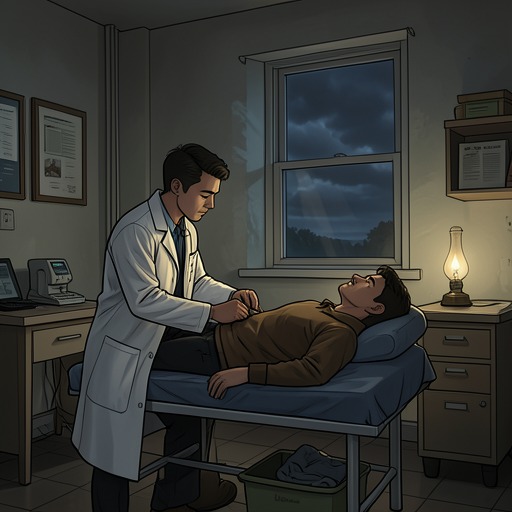
Kwang Jingshu and Gu Wen Kuei first appear as old comrades from their army days, now separated by professional circumstances but still connected by trust. Kwang Jingshu works as a doctor, while Gu Wen Kuei works at the Institute of Infectious Diseases at Chongqing University. When Kwang Jingshu witnesses patients with bites, fever, and alarming changes in the arm, he does not turn first to an official channel. He calls Gu directly, treating the physician as both a trusted colleague and the person most capable of recognizing what the authorities may be concealing.
Their friendship was forged in 1969 during the border clashes with the Soviet Union. In an earthen bunker on the Chinese side of the Ussuri, less than a kilometer downriver from Chen Bao, the two men worked over a wounded soldier while artillery landed around them at roughly seven-second intervals. The patient’s lower intestines had been torn open; blood and excrement covered their gowns, and falling earth threatened to bury the wound. Beyond the entrance, voices and gunfire suggested that Russian Spetsnaz might be moving through the darkness. The two doctors nevertheless bent over the soldier together, making their professional duty a shared act of courage.
The crucial memory is not simply that they survived combat. Gu Wen Kuei, normally a worrier and a fatalistic curmudgeon, looked from the dying soldier to the doorway and then told Kwang Jingshu, “Don’t worry, everything’s going to be all right.” The statement was so unlike Gu’s habitual pessimism that it became an intimate marker between them. The Russians never crossed the river, and the doctors saved their patient. For years afterward, Kwang Jingshu teased Gu about the extraordinary circumstances required to extract even a small measure of optimism from him; Gu replied that conditions would have to become far worse before he would do it again.
The Call During the Outbreak
Decades later, Kwang Jingshu contacts Gu Wen Kuei after an outbreak emerges in the meeting hall. Their initial exchange is deliberately ordinary: they discuss their health and grandchildren, maintaining the manners expected between old friends. Kwang Jingshu then describes the bites, fever, the boy, and the injured arm. Gu’s response changes as he hears the symptoms. His face stiffens, his smile disappears, and he asks to see the infected people through the phone’s camera.
Gu examines the patients remotely and asks Kwang Jingshu to bring the camera closer to the wounds. When the image returns to Kwang Jingshu’s face, Gu’s video has been cut. The interruption turns their private conversation into a controlled emergency. Gu instructs him to remain where he is, record the names of everyone who has had contact with the infected, restrain those already infected, and evacuate and secure any room containing someone who has entered a coma. His voice becomes flat and mechanical, suggesting that he has either rehearsed the instructions or is reading from an established protocol.
Gu then asks whether Kwang Jingshu is armed. The question is the point at which their medical conversation becomes unmistakably militarized. Gu promises that “support” will arrive within several hours, but the phrase carries no comfort: it announces the approach of an apparatus that will treat patients and villagers as subjects to be contained rather than people to be helped. Kwang Jingshu’s later account confirms that the patients are removed on stretchers with their limbs shackled and mouths gagged, while the boy is carried out in a body bag and the village is rounded up for examinations.
Recognition Through Repetition
The friendship’s deepest function is interpretive. Gu does not merely identify unusual symptoms; he understands that Kwang Jingshu is witnessing something larger than an isolated medical incident. Kwang Jingshu realizes this when Gu repeats the old battlefield reassurance: “Don’t worry, everything’s going to be all right.” Because the phrase had once been spoken under artillery fire, and because Gu had spent his life refusing positive predictions, its recurrence carries the opposite of its literal meaning. It tells Kwang Jingshu that the situation is worse than the visible outbreak and that other ears may be listening.
This private code allows the two men to communicate under surveillance without openly naming the disaster. Kwang Jingshu immediately ends the call and tries to warn his daughter in Guangzhou. He advises her to accompany her husband abroad and take their granddaughter with them for as long as possible, but the signal is jammed just as the first helicopter appears. The last reassurance he manages to give his family repeats Gu’s words, showing how the friendship’s language passes from one endangered circle to another even as official communications close down.
The state’s response makes the friendship’s ethical stakes sharper. Kwang Jingshu is arrested by the MSS and held without formal charges; by the time he escapes, the outbreak has spread beyond China’s borders. Gu’s warning therefore gives Kwang Jingshu time to understand the danger and attempt a private act of protection, but it cannot stop the machinery of concealment. Their bond survives as knowledge and memory rather than as a public alliance.
Medicine, Secrecy, and Global Risk
Gu Wen Kuei’s alarm belongs to a wider crisis in which modern systems accelerate infection instead of containing it. Later testimony suggests that infected organs may have entered the international market through transplantation, even when donors were not fully reanimated and traces of the virus took days or weeks to reach a recipient’s bloodstream. The possibility is connected to China’s exploitation of organs from executed political prisoners and to the export of organs, blood, reproductive material, and other biological products. In that context, Gu’s reaction to the first outbreak anticipates the book’s larger argument that disease travels through networks of commerce, migration, medicine, and state power.
The same pattern appears in the broader movement of people and resources. Before the outbreak, Kwang Jingshu’s later account describes smuggling routes from Kashi through the ex-Soviet republics; once rumors spread, professionals, farmers, and government officials sought escape regardless of destination. Fear turns borders into markets. Elsewhere, fear is explicitly treated as a commodity, while refugees are absorbed into labor systems and wartime economies. The friendship stands against that conversion of danger into profit or bureaucratic procedure: Gu’s warning is not a commercial response, and Kwang Jingshu’s call to his daughter is not an institutional maneuver, but an attempt to protect particular human beings.
The relationship also anticipates the failure of conventional systems at planetary scale. The war effort depends on satellites, transport, manufacturing, fuel, and communications, yet these networks are vulnerable to collapse. Military planners confront two hundred million zombies and discover that the traditional requirements of armies—being bred, fed, and led—do not apply to the living dead. Against this impersonal scale, the Kwang Jingshu–Gu Wen Kuei friendship supplies a smaller but decisive form of knowledge: one person recognizes another person’s altered voice, remembers the conditions under which a phrase was first used, and acts before official explanations catch up.
Narrative Significance
The friendship is presented through recollection, reported testimony, and embedded professional histories rather than through a continuous shared storyline. That structure makes the relationship itself a bridge between narrative nodes: a childhood and family warning, a 1969 battlefield memory, a censored telephone call, and later accounts of global transmission all illuminate one another. The past does not merely decorate the present; it provides the interpretive key that makes Gu’s final reassurance legible.
Their bond also embodies the book’s contrast between genuine expertise and institutional denial. Gu can move from casual conversation to urgent clinical protocol because he recognizes the pattern, while official forces arrive under the neutral label of a Ministry of Health and proceed through shackling, blood draws, stripping, and photographing. Kwang Jingshu’s trust in Gu therefore becomes a form of resistance to the state’s managed language. It does not prevent arrest or contain the outbreak, but it transforms a cryptic warning into action and preserves the human meaning of responsibility amid an expanding disaster.